Monday, April 27, 2009

we survived

We promise to post a longer description of our weekend soon, but for now - enough to let you know we are alive.

We (Ted and Todd) wanted to see this :

(pictures are courtesy of past visitors of the park that hung their snap shots on the walls of the reception area at the main gate)


The Park Manager was very friendly. One of us (not Ted or Todd) explained that there was 'some concern about lions'. His response was, "then why did you come here??". He was not a big help.

But all we really saw was this:


We survived and had a great time. more later....

Thursday, April 23, 2009

Todd and Ted's Excellent Adventure {also known as: If my Fate is to be Eaten by Lions, this Weekend may be when it Happens}

So, in a previous post (about the campus unrest, I believe), I mentioned that this semester I have an office-mate. His name is Todd, and he is a professor at Cornell College in Iowa. He is here with his wife, also a professor, and their two kids ages approximately 9 and 6 (one of whom's name is Eden, believe it or not). Anyway, what I failed to mention at that point was that Todd seems to bring out the extreme adventure side of Ted - the side I try to keep a lid on when it involves me and the kids. Todd was the one who invited Ted to climb Kgale despite all manner of warnings and rumors that it was a bad idea (see the post below). Having conquered Kgale, Todd's next big idea, which took no convincing on Ted's part, was that we should all go camping together in the Central Kalahari, where lions and hyenas roam freely and have been known to explore campsites at night. Guess where we are going this weekend...

When we told some other friends this is what we are doing, they promptly went to their computer and pulled up a picture of a big male lion coming out of one of the bathroom-type facilities at the campsite. It should be noted that they did not take this picture themselves, but said that they found it posted somewhere at the entrance to the Reserve or something like that. It could be fake. But still...

So, this is how the conversation went from there.

Me: I am not taking my kids to the Kalahari unless you have a firm plan for what we do when lions come into the campsite.

Ted: Lions are not going to come into the campsite.

Me: They might. Have you not read Cry of the Kalahari??? Lions were in their campsite all the time. {BTW, this is a very great book by two Americans about the three or four years they spent in the Kalahari studying the lions and hyenas, back when virtually no one had done that. They eventually made the government mad and are now banned from the country. Recommended reading.}

Ted: Ok, well we will just be safe.

Me: JUST BE SAFE?? What kind of plan is that?

Ted: Ok, I will look into it.

Me: I am not going unless you have a plan.

Me to Todd the next morning in our office: I am not taking my kids on this trip unless you and Ted come up with a plan for what to do if lions come into the campsite.

Todd: much laughter.

Me: I am serious, and I KNOW you have read Cry of the Kalahari. Then I tell him about the picture of the lion coming out of the bathroom facility.

Todd: Oh, that is not good. If we are going to be eaten by lions, it will be much cooler to do it while fighting them off at our campsite then to just be surprised by them while going to the bathroom.

Me to myself: I am going to die.

Since this time, Todd (but not Ted, I should say) has managed to identify two strategies: firecrackers, and lots of really strong bug spray.

Deb (Todd's wife and I) on the other hand, have tried to think of how we will design the layout of the campsite to have the quickest escape route from the tents to the trucks. Deb also came up with the most intelligent and creative, yet practical, strategy of all: buying Depends for late night emergencies, so as not to have to wander out of the tent in the middle of the night and risk being surprised by a big ferocious beast...

Keep your fingers crossed for us.

Sunday, April 5, 2009

Mountain Climbing


There is a mountain at the edge of town. The top of the mountain (called Kgale Hill, pronounced kahl-ay) stands at 1280 or so meters above sea level. That is pretty high except that most of Botswana sits on a plateau averaging about 1000 meters. So, the 'mountain' is about 900 feet tall. The urban areas of the southwestern part of Gaborone run right up to the base of the hill. You can see the popular 'Game City Mall' in the shadows of the hill below. The hill itself is protected as a vast park area.


It is well known that there is a trail to the top of the hill. In fact, there is a cell tower's red light that acts as a beacon at night. You would think the bulb burns out from time to time. There are many legends and stories about Kgale. For one, security types warn of robbers waiting in the bushes ready to take everything from unsuspecting climbers. Amy's security briefing at the Embassy last year warned of this and stressed not to go there: "A while back a couple drove to the foot of the hill. Husband says 'lets go', wife says 'no'. Husband goes up. Husband comes down in nothing but boxer shorts." Also, there may be man-eating leopards. Officials from the United States (even Peace Corp) are not allowed to enter the area. This of course made finding a way to the top even more intriguing... I (Ted) should bring some of the kids too. To complicate things, the girls' school is nearby. Everyday I dropped off the kids, Kgale would taunt me.


The next round of US expats that went through the Embassy briefings early this year heard of no such warnings. Also, we found out that Kgale groupies scale the peak every Saturday and Sunday morning as the sun rises. Taking the Embassy's silence and the safety of groupies into consideration - I made a plan. A nearby family from Iowa has two girls about Eden and Hope's age. With the increased security of the 'buddy system' we could not fail. Early one Saturday morning (about 7am), the girls and I set off with the family from Iowa. I had enough granola bars and water to last a week in my backpack.


This was the sign at the parking area (one of the lower lower peaks in the Kgale area is an aggregate mine):


There were several dozen empty cars in the parking area, so we figured they had pressed on in spite of the warning. We noted it was Saturday and they likely were not using dynamite on the weekend and started our climb...


The trail is worn and well traveled. The climb is a mixture of large boulders, rocky-rough terrain, sandy trail, and some paved pathway. You start by scaling a lower peak and then back into a valley before scaling the Kgale peak.


In the valley between the two peaks, we saw a troop of Chacma Baboons. They were curious and watched us closely.


The old, grumpy, leader of the troop was hanging out in the shade along the trail. I would like to say his 3-inch canines were safely far away and behind a strong fence, but he was not. He sat less than 20 feet away. We could smell him. By this time, though, we had seen more than fifty climbing groupies heading back down the mountain. The baboon was probably already full of tourists by this late in the morning.


After about an hour, we reached the summit. A bald expanse of an area where groups mingle, rest, and take pictures. We were no exception.


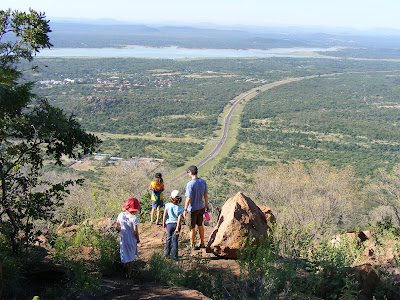
This view (above) looks to the southeast over the main highway 'A1' and the Gaborone Dam. The highway is the main route south and leads to the villages/towns of Otse, Labotse and Mokolodi (the subject of previous posts). Otse is where the mountain cliffs that house the Cape Griffon vultures are located. This is the highest point of Botswana at 1500 meters. The Gaborone Dam is the source of drinking water for the capital city. Gaborone was selected almost fifty years ago to be the capital of Botswana in part because the water supply was considered more reliable. The lake created by the dam is considered more than 110% full this season. The summer rains have been plentiful.

Here are Eden and Hope at the top. Note the power line to the cell tower light in the background. I checked, the bulb was burning brightly.

The trip down the mountain is almost more challenging than the climb up. The rocks are very loose and you really need to concentrate on each step to avoid a spill. Once we returned to the bottom of the mountain, ours were the only cars left. We headed off for breakfast.

We enjoyed the climb so much, we returned a couple of weeks later with the visit of my Aunt Alice. She is well traveled but this was her first time in the Southern Hemisphere. On Easter Saturday, we climbed the 'Sleeping Giant' (what Kgale means) again in spite of the many dangers.


This time, we did not see any baboons. I picked the picture below because of the near-complete green landscape it shows. It is the end of summer now in Botswana and the entire area has exploded with vegetation. When we arrived almost nine months ago, everything was brown and dusty. Local residents say that Easter usually marks the end of the wet season. It will now be dry and near cloudless until October. In that time, the landscape will return to brown, dusty and parched.


Finally, we met a couple of dogs at the summit the second time around. They were traveling with a South African family who do the climb often. The dogs were happy to see us and rested with Eden and Hope.


As Aunt Alice and I caught our breath, wiped the sweat from our face and revelled in our accomplishment; we made a discouraging discovery: The dog pictured above had made it all the way up the mountain - hopping on three legs. Even with a head start, we couldn't beat them back down the mountain. Next time, less granola bars and water bottles in my backpack.


[Footnote: This blog post is dedicated to George, one of our most loyal followers who has been subtly reminding us that it has been a very long time since our last post - even sending suggestions for how to overcome bloggers' block. So, we sincerely apologize for the long delay in posting, if we even have any readers left to apologize to...]

Sunday, March 15, 2009

Tuli Block

Recently, it was mid-term break for the girls ('Spring Break', except its not Spring here). In our ongoing effort to see as much of this country as we can before we leave, we took a road trip to the Tuli Block region of Botswana. We chose Tuli Block for a couple of reasons.
  1. It is at the eastern most point of Botswana, right at the tip where Botswana, Zimbabwe and South Africa meet. This is along the Limpopo River, and it is geologically different than the desert-like conditions of most of the rest of Botswana. We thought it would be pretty and interesting.

  2. The real reason: It gave Ted an excuse to rent a massive 4x4 diesel truck for the trip. The 6 hour road trip to get there includes very rural and rocky terraine that Ted insisted required the use of the crew cab Toyota Hilux pictured below. It actually was more of a necessity than we knew - the Corolla simply would not have made it. The last 50 kilometers of our trip were on some very challenging, axel-breaking rocky dirt roads and included a washed-out bridge that required us to literally drive through a river. Ted was in heaven.

We stayed at the Mashatu lodge (http://www.mashatu.com/). Much like other lodges, it includes a morning drive to seek out wildlife and an afternoon/evening drive. A drawing point, though, was that the lodge also houses scientific researchers. Three scientists are currently there, studying wild dog re-introduction, lions/leopards, and elephant populations. To raise money to fund their research, you can hire them to ride along with your drive and explain their research.

The elephant research is lead by Jeanetta Selier. She has been at Mashatu for more than ten years and is studying elephant population management. Her work counters the prevailing choice to cull (kill) elephants when their populations seem too high. She is attempting to document that the elephants have the ability to monitor and control their own populations.

We spent a morning with her and learned more about elephants and the intricate social interactions of their daily lives. The video below captures a moment when a juvenile bull thought we were a little too close.


We also saw giraffe.


We spent an afternoon and early evening with Andre (we didn't get his last name) who is researching the terrritorial tendencies of lions and leopards. He has several lions and leopards fitted with radio collars. He taught us how he uses his equipment to track them. In the video below, Eden is trying her hand at it as we track a male leopard:


We were on the trail of a leopard named "Skebangwa" (which means 'fearsome'). By dusk, we finally caught up with him, although he was cleverly evasive and we were always looking at him through trees or tall brush. (no pictures turned out - too dark) We first found him jumping out of a shephere tree where he had been feeding on a baby impala he hid there. He had a severe eye wound (from being scratched by a female, according to Andre), and Andre noted that it was getting worse each time he finds this leopard. When we got back to the lodge he showed the girls lots of photos he has taken of this leopard over time, including the progression of the wound. Despite their ability to do so, they do not interfere in the lives of the animals, unless the wound is man made. In this case it was not. They do not expect that he will survive the wound.

As an added treat, two hyena (a mother and cub) waited near the shepherd tree for impala leftovers. It was the first time we had seen hyena in Botswana. They are Amy's favorite, but she appears to be the only person in the country who feels that way. Of the thousands of animal souvenirs of all types (figurines, shirts, posters, photos, etc., etc) for sale in this country, you can not find ANY hyena souvenirs anywhere. Apparently not much of a market; someone told us they are a symbol of bad luck (recall the nasty and evil hyenas in Lion King...). Oh well, we have this photo.


A special interest for Ted was getting close to a Baobab tree (Adansonia digitata). They are more familiar to people in the dry season after they have dropped their leaves (it is late summer in Africa now). Without the leaves they appear to be upside down with the roots instead sticking high into the sky. Our guide explained that folklore throughout the area says that God made these trees last and instead of carefully planting them, he tossed them down to the ground and they landed upside down. These giants live for thousands of years and dot the horizon if you know what to look for in the area we were visiting. Our guide took us to the foot of a very young Baobab at the top of ridge. They estimate the age of the young tree at 500 years. A short time after Columbus discovered America.


Near the Baobab tree, we stumbled across an almost entirely complete giraffe skeleton. We explored the skeleton and even matched up some of the bones to ours (thigh bone to thigh bone). Ted says the neck bones were as large as his waist.


In the picture below are our guide and driver, Mallman, and our tracker, Morgan, with the giraffe bones. The are both Batswana who have worked at Mashatu for several years. They knew their stuff.


Another unique experience was the ability to actually get out of the safari vehicles and hike. Mallman carried his rifle and Morgan stayed far back with the Land Rover. We had to stay in single file formation so that Mallman knew where we would be if a hungry warthog jumped out at us (the only animals we saw on the hike - upwind).


We tasted wild berries, smelled minty leaves, saw more bones (below of an unfortunate male impala):


And no safari would be complete without examining some poop. First, elephant. Apparently those who spend their time thinking about such things can tell from the composition of the elephant waste about the quality of the previous summer's food availability. The grassier the better, or something like that.


Perhaps more interesting (again, if you spend your time thinking about this kind of thing) is from the hyena:


Hyena have the strongest jaws in the animal kingdom and eat their prey like we do a peanut butter and jelly sandwhich. The grind and crush the bones as if they were crust on the bread. Becuase of this, their waste is powdery white from the ground calcium that is left behind.

Shortly thereafter, we decided it was time to get back in the Land Rover.

Lastly, we (Ted) saw a buried water pipe (daughters grumbling). The terrain is very rocky so the piping is buried very shallow. The rocks were added in this area to protect the piping (the only water supply to our camp) from the heavy footsteps of elephants.

Saturday, March 7, 2009

The Rest of the Story & An Ode to German Print

It has been a while since we have posted, and a few people have pointed out to us that we have left a couple of stories unfinished. So, here you go:

The Rest of the Story Part I: Campus Unrest
After they closed the campus in the middle of the week due to the violence, it was announced that the campus would stay closed for the rest of that week and the whole following week. To make up for it, the mid-semester break was cancelled, and the semester was extended by a week. Then a couple days later, it was clarified that this cancellation did not apply to graduate students or international students. Now, if you are paying attention, you will have noticed that means that if you teach both graduate and undergraduate classes, you have had your mid-semester break taken away, your semester extended by a week, AND you did not get the week off for the cancelled classes. And, if you are an international student or an exchange student, enrolled in undergraduate classes - do you have class during the off week, or do you not? None of this made much sense - totally poor "planning", if you can call it that. So, there was a bit of confusion and mild unrest on the part of the faculty at that point. Honestly, I think most faculty just made up their own minds of how they would handle the schedule situation, without broadcasting it to administration.

When students returned after the semi-closed week, the unrest actually started right back up. This lasted a couple of days, in which some classes were again disrupted, sand thrown in the face of professors, etc. At this point the faculty and staff had lost their patience with the administration and called a meeting to organize a bit of protest of their own. They confront the Vice Chancellor, took a vote of no confidence in him and called for his resignation. At that point there was some talk that the university would have to close for the entire semester.

Then...suddenly...it all got quiet again. Things for the past week have seemed completely normal. I finally asked my grad assistant what had happened, and she said that they (the govt. or the university, not sure which) had given the students money. Problem solved. (?)

The Rest of the Story, Part II: The Dogs.
Mama (the dog) had her puppies. Only two this time, not eight (thank God!). She had them in her own front yard, not ours (thank God, again). The SPCA did finally come for a visit, but it happened to be a day in which the owners had taken a tiny bit of interest and moved the puppies to the back yard, where it could give the appearance that they were being tended to. We reminded the SPCA that the reason none of the dogs were starving was that we were feeding them (not the owners), and that it is not a sustainable situation once we are gone. They took no action but promised to come back. In the meantime, we have not seen or heard the puppies in a week or so. We are not sure they are still there. If they are gone - and we absolutely hate to think of how that was done - it happened much sooner than with the last batch, and before the girls could get completely attached. So, life goes on with us having two informal foster dogs that do bring pleasure to the girls and a combination of pleasure and terror to Trey. And, they bring us gifts. Today I got a chewed-up but otherwise lovely pink slipper - just one - from who knows how far away...

An Ode to German Print:
Now, a bit of fun Tswana culture. The traditional clothing of the women here is known as German Print. The fabric comes in three colors (blue, brown, and red) and a seemingly endless variety of patterns. You can buy the fabric in any of a large number of fabric shops, then take it to any one a very large number of tailors to design you a dress or skirt. (There are some street vendors that sell pre-made dresses, but the vast majority seems to be made-to-order). This is seemingly done by even the poorest of people, and german print seems to be in style for every occasion. You see people wearing a german print skirt with an old t-shirt and slippers, or very elaborately decorated for a wedding or other special occasion. Once you figure out what you are looking for, German Print is everywhere.

Way back in November, Charles (my Fulbright colleague) and I were invited to the wedding of one of Esther's relatives (Esther is the director of the Centre). Weddings are much more drawn out affairs here, with festivities one weekend at the bride's family home, followed by festivities at the groom's family home the next weekend. The roles and responsibilities of the extended family in family life here are extensive. This includes weddings. The extended family women, on the bride's side, lets say, prepare all the food, serve it, and clean, while acting as gracious hosts to the family of the groom. Then, the next weekend, it is the groom's family's turn to do all the work (the women, that is).

The fun part is that each side picks out a specific german print pattern and all the women on that side have dresses made from that pattern, each trying to quietly outdo the others with ornateness and originality. At the wedding that Charles and I went to, we didn't know anyone but Esther, and she was busy with the extensive hosting responsibilities. So, we amused ourselves by seeing how many different interesting german print dresses we could find. I forgot my camera, but thanks to Charles, here are some interesting photos to give you the idea.
This wedding took place in the village of Molepolole (mow-lep-e-low-lee), about 50 km from Gaborone. In addition to giving you some good representations of the german print style, I hope they will give you a good feel for village life in Botswana, which to me can feel very different, strikingly different at times, from life in Gaborone.
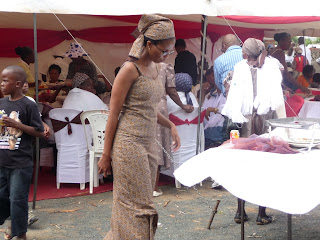
Above is a fancier brown print. The cut of the skirt and top suggests it was made just for the wedding. It may be from the print chosen by the women of the groom's family, but I can not tell for sure.

Two good representations of the blue print. Charles and I were both in agreement that the red sash and collar on the left were quite unique, and quite striking. The one on the right is a much more traditional look.


The picture above is a pretty good representation of what I would call the "classic" german print style. A small print fabric, with some details added at the neck, shoulders, and around the bottom. The white shawl indicates she is from the bride's family, and is therefore a guest of honor at the home of the groom. The weekend before, the groom's family members would have been wearing the shawls at the home of the bride. I just love this picture, it seems like such a classic representation of Botswana village life or something.


Another brown. I call this the "button" print, just totally my own made-up term. I believe this was the print chosen by the groom's family, You will note the woman is wearing an apron, as she was probably clearing the tables and doing dishes as this photo was taken.


There are three separate prints in the shot above. The "button" style with the yellow t-shirt underneath, the blue stripe (which is a bit more unique, or at least I do not see a lot of the stripe when I am paying attention), and another brown in the background, with a matching hat trimmed in the same fabric. You do see a lot of coordinating scarves for daily wear, and hats for fancier occasions. This morning we went to a tailor (to get a pea costume made for Hope for book week - more soon on that). We found out there that you can also get shoes made with the fabric as well. I asked if you had to buy the shoes and he just covered them with the fabric, but the tailor said no, just tell him what size foot you have, and he makes the whole shoe himself. How cool is that??


Above is a member of the wedding party, in a lovely brown print mixed with a lot of white. The wedding party started out in a more Western style of gowns and tuxes. After the food and some dancing, they left. Charles and I thought that was odd. Then maybe 30 minutes later they returned. This time the women were all in german print and the traditional leather sandals with goat hair (I have been assuming it is goat - it could be any number of animals, I suppose). The pattern was all the same, but again each woman's dress was unique.


Two other members of the wedding party in their own versions of the same print, with the men in the background. They are doing what could best be described as a line dance of sorts. It was a lot of fun to watch. We were told the wedding party had been getting together and practicing for weeks to prepare for it.


And finally, a nice red. I think red is the least frequently seen of the colors, but it is a bright and fun contrast to all the blue and brown. In the background is another "button" style of brown.


The girls have become quite interested in the whole german print idea. So, we are having dresses made for each of them. I took Hope to the tailor last week, and she had such fun as the lady got a pad of paper and a pen and started sketching out ideas, while asking Hope for input. It will be a two-piece skirt and top, in a red rosette-like print as the main color, but with layers of blue and brown in the same print at the bottom of the skirt, finished off with a bit of lace. Once hers is finished, we will take Eden to do the same thing. Today at the fabric store we found some prints with elephants, others with zebras. Guess what Eden's dress will probably look like?


Ted and I seem to have caught the bug ourselves. Today at the fabric store we decided we might get some of it to bring home and recover the seats of our dining room chairs. We are thinking brown, with a variety of different prints - maybe even a different print for each of the six chairs...

Sunday, February 15, 2009

Trey's World


A Ted Post:

Trey is now 3 1/2 years old. When we arrived in Botswana, he was still struggling to tell us in words about his world. Now, I often call him a chatter-box. He uses words like 'actually', 'tremendous' and phrases like, "Lets think about it." and "That is not a good idea". The last one usually right after we tell him to go to bed.

At his nursery school, they usually do a couple of pictures to take home. We have an entire wall full of his art. When I picked him up the other day, I was especially interested in his most recent work (above). Keep in mind that for over six months now, all of our laundry is done by hand in the bathtub. When I asked him what he had just colored, he answered:

"Its a TV, Dad!".
Amy and I looked at each other in confusion for a moment, then realized the kid probably has no memory, mental image, or word for something called "washing machine".

Saturday, February 7, 2009

Puppies and Poop.

A Ted Post:
A long standing issue at our flat is the dogs next door. You may remember shortly after our arrival stories of the mother dog and her eight puppies. There has not been much good news to report except for the tremendous love that Eden, Hope and even Trey (at times) give to them.


Seven of the puppies left our neighborhood in November but one (by name of 'Mocha' if you ask Eden or Hope or 'Cheese' if you ask Trey) remains. The mother and son duo wander around the nieghborhood, hang out in our yard, eat some of our table scraps, hide on our front porch when it rains and steal the occational shoe or toy from us.

Amy and I are worried about what happens when we leave. The neighbors aren't showing much interest and the doghouse in their backyard hasn't been available to both dogs in months. There are too many beer bottles and trash.

We considered 'adopting' Mocha-Cheese and bringing him back to the states, but then found out the cost. For anyone considering transporting a dog halfway across the world, a full service company will handle all the details for around $7,000. Then we noticed a couple of weeks ago that 'Momma' (the dog, that is) is again pregnant. We stepped up our search for options.

To our suprise (and relief) their is a Botswana Society for the Prevention of Cruelty to Animals (BSPCA). Eden and I checked it out during the week.
They house lots of cats and dogs, some bunnies, three donkies, some goats, and a sheep.
Eden, Hope and I returned on Saturday to volunteer. I was thinking we could walk a couple of dogs, pet some cats, sit with the bunnies. They had different ideas...When we checked in at the office, Kay (the office manager) said she was glad to see us and asked if we were ready to work. We said yes. She had me pick from two different shovels (an odd tool for walking dogs, I thought). She then lead us to the donkey/goat/sheep pen. It was empty (they were wandering around the entire place). The shelter however, was not entirely empty. It was full of poop. Lots of it. This was our task. Good thing I wore my brand new (birthday gift) white shirt.

While I shoveled and dumped, Eden and Hope helped feed the several dozen animals at the shelter.

After feeding the animals, Eden even chipped in to help with the poop - see video below.


We came home dirty, tired, but feeling good about the place itself. We wish we were also feeling good about the fate of the dogs and future puppies next door. The BSPCA has promised to pay the neighbors a visit, but so far they have not come. We have heard the neighbors may be leaving and the dogs going to the village where the neighbors come from, but if that does happen, it almost certainly won't happen before the new litter of puppies is born. Eden and Hope have already picked out names for up to 10 of them...